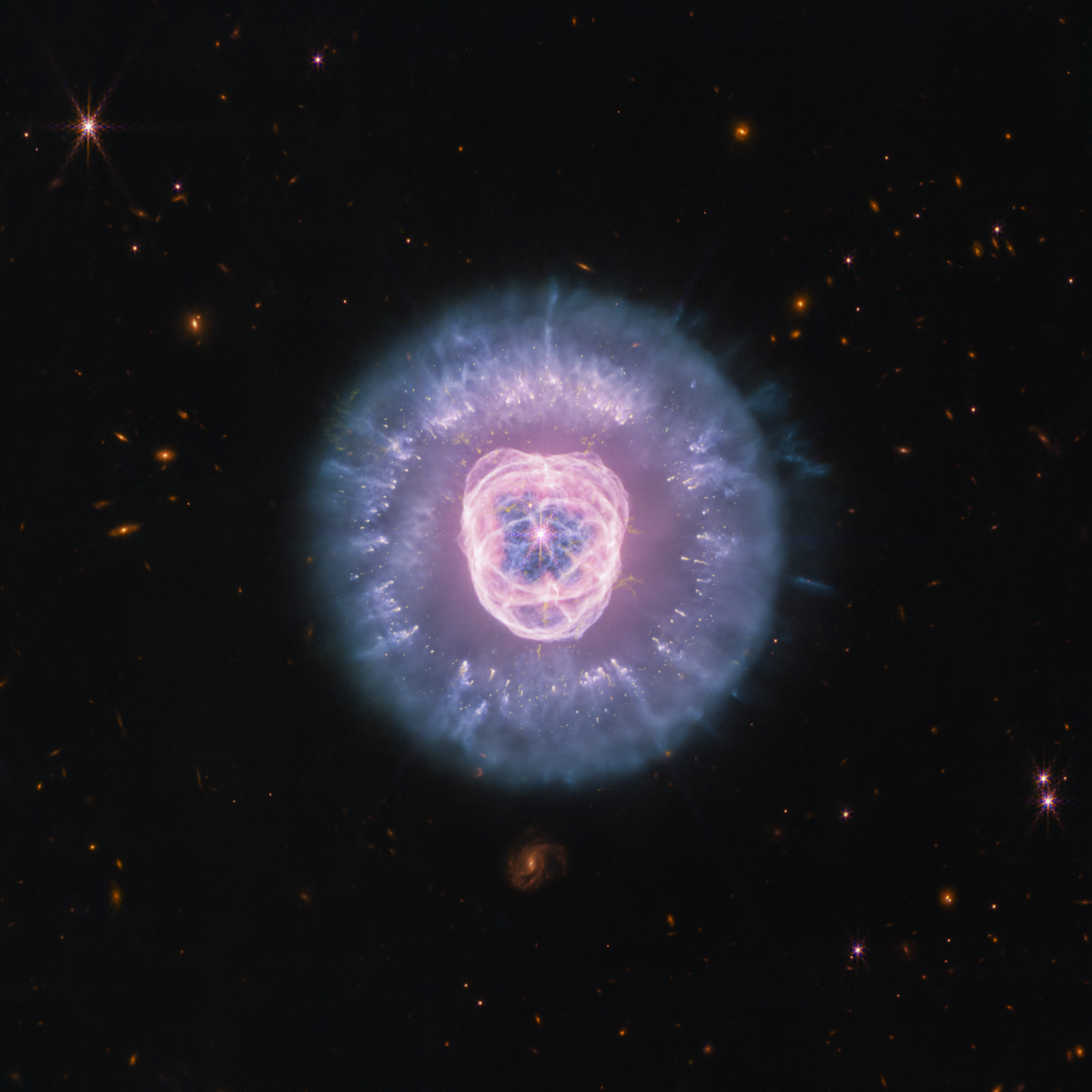
The James Webb Space Telescope has produced new infrared images of NGC 2392, the planetary nebula informally called the Lion Nebula, revealing finer detail than was visible in earlier observations, the European Space Agency said on August 10, 2026.
The NASA/ESA Hubble Space Telescope first observed NGC 2392 in 2000, capturing it in visible light. Those images showed a "mane" of hazy, comet-shaped objects surrounding the nebula. Webb's new views, taken with its Near Infrared Camera and its Mid-Infrared Instrument, are clearer and more detailed than Hubble's, according to the European Space Agency.
The new images show compact dust clumps and a haze of ionised gas within the nebula. At the center sits a white dwarf, the remnant of a dying star whose energy drives the intricate structures around it. An expanding bubble of ionised gas forms the lion's face shape and is destroying dust in its path, while swept-up gas displays rings and shells, a common feature of planetary nebulae.
The lion's mane appearance comes from the interior of a dust shell lit by the central white dwarf. Comet-tail-like tufts are compact dust clumps that survived the white dwarf's radiation and shield the material behind them. The nebula's gas and dust took several thousand years to reach their current form and continue to change, with both components gradually migrating away from the stellar core.
Astronomers estimate NGC 2392 will fully disperse in approximately 10,000 years, a period the European Space Agency describes as relatively short in astronomical terms.